Sindhi Aseel · Breed Standard
Sindhi Breed Standard
Introduction
The term Aseel (also spelled Asil) is an umbrella designation used across Pakistan and India to describe game-bred fighting fowl that have been selectively developed over centuries. These birds are renowned for their courage, stamina and resilience, with their names often reflecting either the region in which they were bred or the fanciers and breeders who established celebrated lines of champions.
The word Aseel/Asil originates from Arabic (أصيل) meaning “pure” or “noble,” and in Hindi (असली) it translates as “real” or “true.” Among the recognised varieties is the Sindhi Aseel, originating from Sindh in Pakistan, which has contributed to the rich tapestry of this ancient and enduring breed.
- Origin
- Pakistan (Sindh)
- Classification
- Heavy breed, Asian Hard Feather
- Egg colour
- White or brown tinted
- Mass — male
- 4 kg max
- Mass — female
- 2.7 kg max
The Male
Head
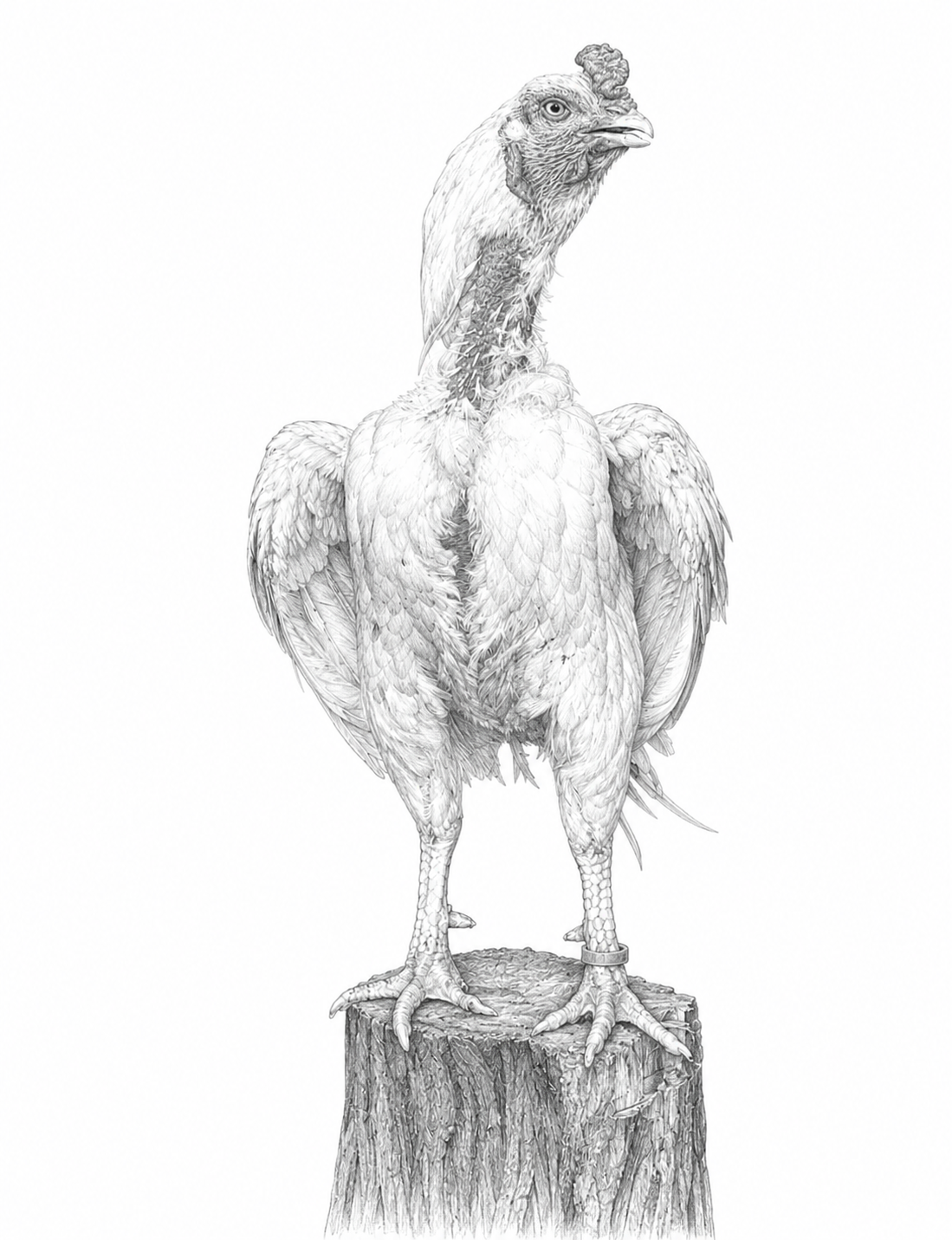
The head of the Sindhi Aseel is broad and thick, never fleshy. The skin should be tight and firmly set. The face must be a deep red in colour, largely free of feathers, though small cheek feathers are permissible. The comb should be prominent, sometimes with three ridges as in a pea comb, though less pronounced than in the Atkinson Asil. A slight fold may appear just above the beak where the comb begins. The comb is relatively large, serving to deflect blows away from the head and eyes.
Wattle and lobe development should be minimal, never as pronounced as in Old English Game. The beak must be strong, short, and pearl white in colour; in some cases a faint brown tint may be visible at the base. The eyes should be a deep pearl, or pearl with a slight bloodshot ring. Rarely, a light blue pearl is acceptable. Any off-colour eye is a disqualification. (Young birds may show slightly darker eyes, which should lighten by around 8 months.) Slight white colouring on the lobes is acceptable.
Neck
The neck should have a slight curve, covered with medium-length feathers. In some individuals, parts of the throat and neck may be bare, but the skin must remain a deep red. The neck should be muscular and proportionate to the length of the thighs and shanks, ideally equal in measure, producing a well-balanced bird.
Body
The body must be well-muscled, firm, and strong, never fat. The breast and back should be proportional, with well-developed muscles. Thigh muscles may protrude, but must remain symmetrical. The back must not appear skewed or uneven. When held in the traditional manner — gripped firmly around the breast and above the thighs — the bird should remain calm and steady, not startled or restless.
Wings
Wings should be firm, strong, and set higher on the shoulders than in Old English Game or the standard Reza Aseel. Shoulders may be carried slightly away from the body and raised, somewhat in the style of the Shamo.
Thighs and Shanks
Thighs must be strong and positioned directly beneath the bird, giving the appearance that it stands on its legs, not between them. Thighs must not protrude to the sides. Shanks should be strong, well developed, and pearl white in colour, though a slight reddish or pinkish hue is permissible. In males over two years, the shanks should begin to square off as scales mature; rounded shanks are acceptable in younger birds. Spurs must be white and either straight or downward curving; upward curving spurs indicate impurity. Toes must total four: three front, one rear, with slight crookedness tolerated but not deformity.
Type and Appearance
The Sindhi Aseel should stand proudly upright, with the tail following the line of the back at roughly 45° in relation to the ground. A slight lift is acceptable, but a horizontal tail is not. The neck should curve when the bird is standing upright, with shoulders carried slightly away from the body and raised, though less exaggerated than in the Shamo. The wings must fully cover the sides of the body and extend to cover the base of the thighs. Wings must never hang down as in the Shamo, nor sit tightly against the body as in Old English Game.
Plumage
Feathers should be short, flat, and hard to the touch, with minimal down. The tail should be neat and composed of strong feathers; saddle feathers must be present but never extravagant. Two sickles may appear in the centre of the tail, straight with only a slight basal curve. Bare spots may occur on the neck, chest, or wing joints, but exposed skin must always be deep red in colour.
The Female
Head
The female’s head should be broad and strong, though slightly more refined than the male’s. Wattles and lobes should be absent or extremely minimal, and the comb small and firm. The beak should be strong and white, and the eyes identical in colour to the male’s. A pronounced brow ridge is desirable, lending a stern expression. Slight white colouring on the lobes is acceptable.
Neck
The neck should follow a similar curve to the male’s, but with shorter, tighter feathering.
Body and Wings
The body should be firm, slightly elongated, and proportionately feminine compared with the male. All key features should be present but less pronounced. The tail should follow the line of the back, with wing tips pointing toward the tail tip. She should stand upright and proud.
Thighs and Shanks
The thighs and shanks must mirror the male’s proportions. Shanks may remain firm and rounded. Spurs are rare but not unknown.
Type and Appearance
The female should be a feminine reflection of the male: upright, proud, with a curved neck and well-developed chest. Wings are less pronounced than the male’s, but the tail must follow the back line closely.
Plumage
Feathers should be short, tight, and firm. The wings must match the male in strength. Female traits should be evident: short, strong tail; no hackles or saddle feathers.
Colours
The Aseel may be represented in Pumpkin, White, Cinnamon Tinted, Silver Duckwing, Grey Duckwing, Spangled, Black, or Light Red and Black. In black varieties, slight pigmentation of the beak and shanks is permissible. Sub-varieties of black, such as Silver- or Golden-hackled, are also acceptable. Traditionally, colour distinctions have not been prioritised, as Aseels were historically judged on performance and gameness rather than plumage.
Defects and Disqualifications
- Off-coloured eyes.
- Tails in males lifted horizontally as in the Reza Aseel.
- Flat or low carriage lacking upright stance.
- Upward-pointing spurs.
- Fleshy or heavily feathered faces.
- Yellow shanks or beaks.