Mianwali Aseel · Breed Standard
Mianwali Breed Standard
Introduction
The term Aseel (also spelled Asil) is an umbrella designation used across Pakistan and India to describe game-bred fighting fowl that have been selectively developed over centuries. These birds are renowned for their courage, stamina and resilience, with their names often reflecting either the region in which they were bred or the fanciers and breeders who established celebrated lines of champions.
The word Aseel/Asil originates from Arabic (أصيل) meaning “pure” or “noble,” and in Hindi (असली) it translates as “real” or “true.” Among the recognised varieties is the Mianwali Aseel, originating from the Mianwali district in Punjab, Pakistan, which contributes to the rich tapestry of this ancient and enduring breed.
- Origin
- Pakistan (Mianwali, Punjab)
- Classification
- Heavy game-breed, Asian Hard Feather
- Egg colour
- White or brown tinted (traditionally)
- Mass — male
- approx. 3.0 kg max (mature show/exhibition type)
- Mass — female
- approx. 2.2 kg max
Note: In field practice some breeding males may exceed these weights slightly; however for breed standard purposes the above maxima aid in the type and athleticism.
The Male
Head
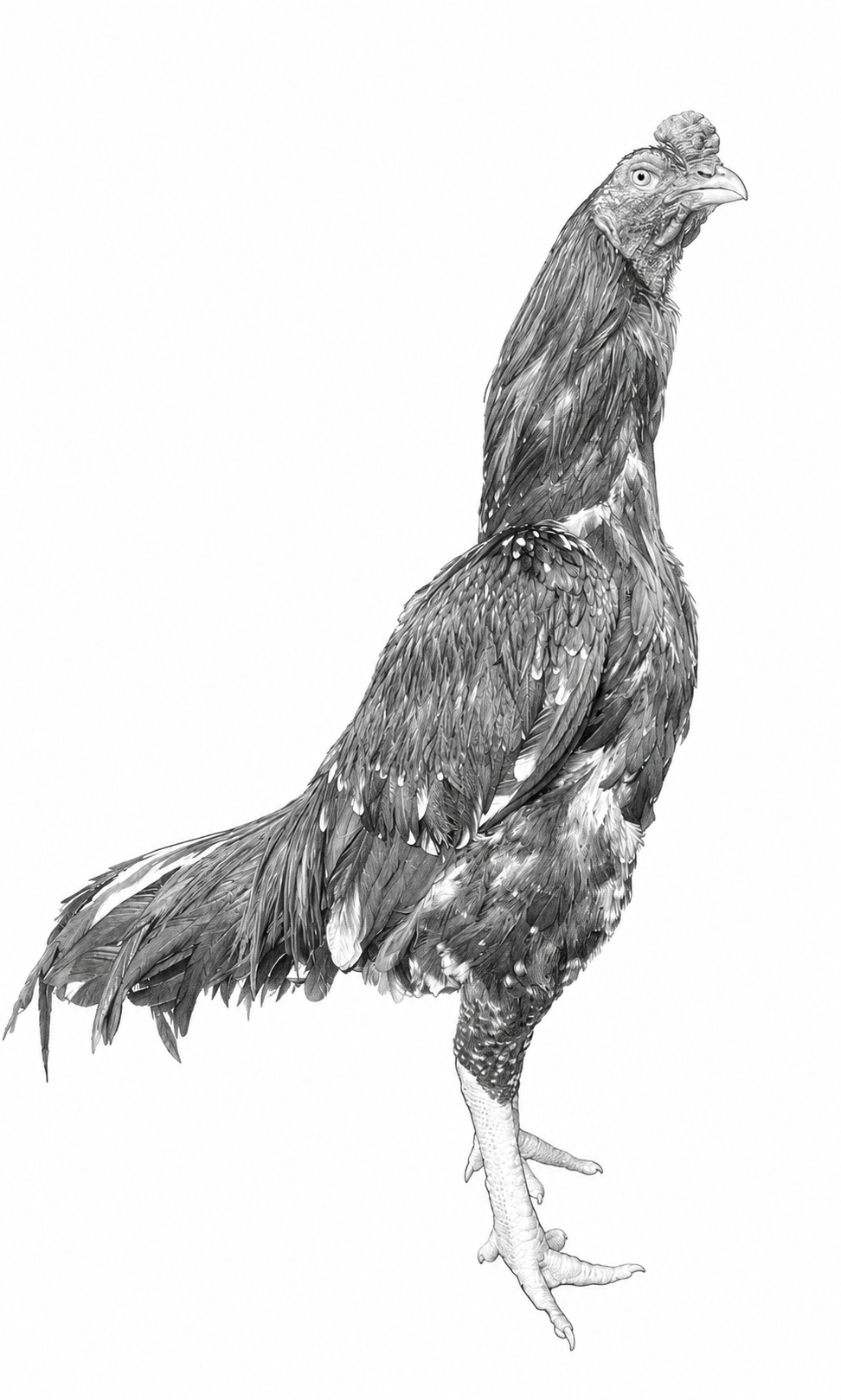
The head of the Mianwali Aseel is slightly more elongated than some other Aseel types, maintaining strength and fierceness rather than bulk. The skin should be tight and firmly set. The face must be a deep red in colour; feathering on the face is minimal and no muffs may be present around the loabs. The comb must be a small to medium pea-comb, firm, well defined but not large or floppy. Wattle and lobe development should be minimal — virtually none of the heavy wattles of some fowl breeds.
The beak must be strong, short to medium in length, well-proportioned to the head, and may vary in colour from deep yellow, to horn, to pearl, with possibly a faint brown base. The eyes must be a strong pearl (white-pearl) or pearl with a slight blood-shot ring; any off-colour eye is a disqualification. The expression should be fierce, alert and unwavering.
Neck
The neck should have a strong, handsome curve, showing athletic carriage. The neck plumage may vary from bushy, rising feathers to a slender, tightly feathered appearance depending on the sub-strain, but overall the neck plumage is generally longer than in many other Aseel types and the feathering is thicker than one would find in other strains or variants. The skin underneath must continue the deep red of the face. The neck must be muscular, proportional to the thigh and shank length, contributing to the upright athletic stance.
Body
The body must be exceptionally well-muscled, firm and strong, never flabby. The breast and back should be broad, showing clear development of muscle — especially across the breast region and the shoulders. The thighs should be well developed and may protrude slightly but must remain symmetrical. The back should be straight to slightly concave from shoulders toward tail — the back and tail must form a flowing concave to straight structure, not highly arched nor drooping. The stance is upright and proud.
Wings
Wings must be strong, hard and firm; flight feathers must be of high quality such that when tapped lightly the wings and flight feathers produce a hard knocking sound, indicating density and strength. They may be set slightly away from the body at the shoulders — predominantly positioned as such when males are with females or contesting other males, but not excessively as in some Shamo types — and should fully cover the sides of the body and reach to the base of the thighs.
Thighs and Shanks
Thighs must be broad, muscular and positioned directly under the bird so that it appears to “stand on its legs,” not sprawl between them. Thigh musculature should be visible and powerful in proportion to the body.
Shanks must be thick and strong, shaped either square or rounded, never narrow or weak. The leg colour may vary from deep yellow, to horn, to pearl, depending on the strain and individual pigmentation. Spurs in mature males must be strong; they may be straight or upward-curving (upward curving is acceptable in this standard, though an extreme cork-screw upward spur is not preferred and results in a disqualification). Toes must total four — three front, one rear — with minimal distortion; slight crookedness is tolerated but not structural deformity.
Type and Appearance
The Mianwali Aseel should stand proudly upright, with a pronounced neck curve, broad chest and powerful shoulders. The tail must follow the line of the back and should be carried at a moderate angle — not flat horizontal, not overly vertical. The back and tail transition should form a flowing concave to straight line. The thighs and shanks should support the body firmly, giving an appearance of stability and readiness. The whole bird should radiate athleticism, power and game-type presence rather than mere ornament.
Plumage
Feathers should be short, flat and game-hard to the touch, but the firmness may vary between sub-varieties. The most important aspect of plumage quality is the strength and hardness of the wings and flight feathers.
The saddle feathers may be flashy and well established, hanging neatly alongside the tail feathers and starting relatively high up on the back. The tail feathers should be long and flowing, with a somewhat bushy appearance, and may fan open slightly at the tip.
Overall the bird must retain the distinct “game” character of hardness and firmness, even though texture variation between sub-strains is acceptable. Bare spots may occur, for example on the neck or chest, reflecting game heritage — but exposed skin must always be the deep red characteristic of the breed.
The Female
Head
The female’s head should be strong and broad but slightly more refined than the male’s. The comb must remain small and firm (pea-type), and wattles and lobes should be virtually absent or extremely minimal. The beak must be strong and of deep yellow, horn or pearl colour, matching the male’s possible range. The eyes must match the male’s best colour standard — strong pearl or pearl with a slight blood-shot ring. The expression should be sharp and alert with a pronounced brow ridge conveying a strong character.
Neck
The neck should mirror the male’s curve but with slightly shorter, tighter feathering if the sub-strain dictates. The hairline of the feathers may differ in the female but the underlying skin remains deep red.
Body and Wings
The body should be firm, slightly elongated compared to the male, while retaining femininity of form. The wings must be strong and well-feathered, though less pronounced than the male’s. The tail should follow the back line closely, carried at a moderate angle, not overly long or extravagant. She should stand upright and proud.
Thighs and Shanks
The thigh and shank proportions should mirror the male’s in structure — strong and well set — though shanks may remain slightly more rounded rather than squared. Leg colour may vary from deep yellow, to horn, to pearl, as in the male. Spurs are rare, but if present should be small, straight and downward-curving.
Type and Appearance
The female should appear a feminine reflection of the male: upright stance, pronounced neck curve, strong chest and a well-set tail. The overall impression is one of readiness and athleticism, not softness or heaviness.
Plumage
Feathers should be short, tight and firm, though slight variation in firmness may occur among sub-varieties. The wings must remain strong, and the saddle region should flow neatly toward the tail, maintaining the “game” appearance. Females may exhibit a broader range of colour variations than males, particularly softer shades or lighter tones of the recognised game colours. No extravagant hackles or saddle feathers as in males. Tail length moderate but flowing, fitting the body.
Colours
All game-colour varieties of the breed are accepted, as per tradition, with the exception of crele or koekoek type patterning, which is disallowed in this standard. Acceptable colour varieties include, but are not limited to: Red (Lal or Lakha), Black (Kala or Mushka), Silver Duckwing (Jawa), Grey Duckwing (Sawa), Spangled (Cheena), White (Heera), and Light Red & Black. In black varieties slight pigmentation of the beak and shanks is permissible. Sub-varieties of black, such as Golden- or Silver-hackled, are also acceptable. As with historic Aseel types, plumage pattern and colour is secondary to type, structure and gameness.
Defects
- Weak or flabby muscle structure (breast/back insufficiently developed).
- Thighs poorly set — protruding sideways rather than directly beneath.
- Wings soft or lacking hard flight feathers (no firm knocking sound).
- Tail carriage too horizontal (flat) or too vertical (over-carried).
- Shanks too thin or weak; toes extremely deformed or more than slight crookedness.
- Feathers excessively soft or downy.
- Face feathering forming muffs around the loabs (not allowed).
- Comb not the pea-type, or wattles/lobes pronounced.
Disqualifications
- Off-colour eyes — not strong pearl or pearl with a slight blood-shot ring.
- Presence of crele or koekoek pattern in plumage.
- Fleshy or heavily feathered face (muffs or loab feathering).
- Tail carried horizontal or too drooped, indicative of poor type.
- Shanks or feet clearly showing deformity, extra toes, or severe crookedness.
- Comb type other than pea-comb, or a large floppy comb/leaves.
Notes on Sub-Strains
Although various sub-strains of the Mianwali Aseel exist, all share the core phenotype described above. Some sub-strains may emphasise longer neck plumage, slightly more slender feathering on the neck, or slightly more upright tail carriage — but the structure, muscle, carriage and game-type presence must always remain consistent. When judging or breeding, priority should be given to the core attributes of face, comb, neck curve, body muscling, wing and flight-feather strength, thigh and shank robustness, and correct tail-to-back line.